
When most people think about replacing a missing tooth, they focus on the obvious: the gap in their smile. They think about how it looks, how it feels when they eat, or how it affects their speech.
But tooth loss has a hidden consequence most patients never consider. It’s happening right now, beneath the surface, and it could be quietly changing the shape of your face.
We’re talking about bone loss. It’s one of the most compelling reasons to consider dental implants in Bryn Mawr, PA. They are a long-term investment in your health and appearance.
The Unseen Consequence of Missing Teeth
Your jawbone isn’t like the bones in your arms or legs. It has a very specific job: supporting your teeth. Every time you bite or chew, your teeth send tiny signals through their roots into the surrounding bone. This constant stimulation keeps your jawbone healthy, dense, and strong.
Here’s what happens when you lose a tooth. That stimulation stops. Your body is incredibly efficient, and it assumes this area is no longer needed. It begins to reabsorb the bone tissue, a process called resorption.
This doesn’t happen overnight. But it starts almost immediately after you lose or extract a tooth. It continues for years, quietly shrinking the bone volume in that area.
The Domino Effect on Your Facial Structure
This isn’t just about having enough bone for a future implant. This process directly affects your appearance.
The jawbone is the foundation of your lower face. It supports your lips, cheeks, and overall jaw contour. When the bone begins to resorb and shrink, that support diminishes. Over time, this can lead to:
- Sunken cheeks: The loss of bone volume in the upper jaw can make your cheeks look hollow and less full.
- Thinner lips: Without the support of a healthy jawbone and teeth, your lips can lose their natural shape and fullness.
- A collapsed smile appearance: Your mouth can appear to “turn inward,” creating a prematurely aged look.
Many people accept these changes as just a part of getting older. But in many cases, untreated tooth loss and the resulting jawbone deterioration quietly contribute to that aging appearance. It’s the kind of thing you might not notice happening, but you’ll definitely see the results over time.
How Dental Implants Solve This Problem
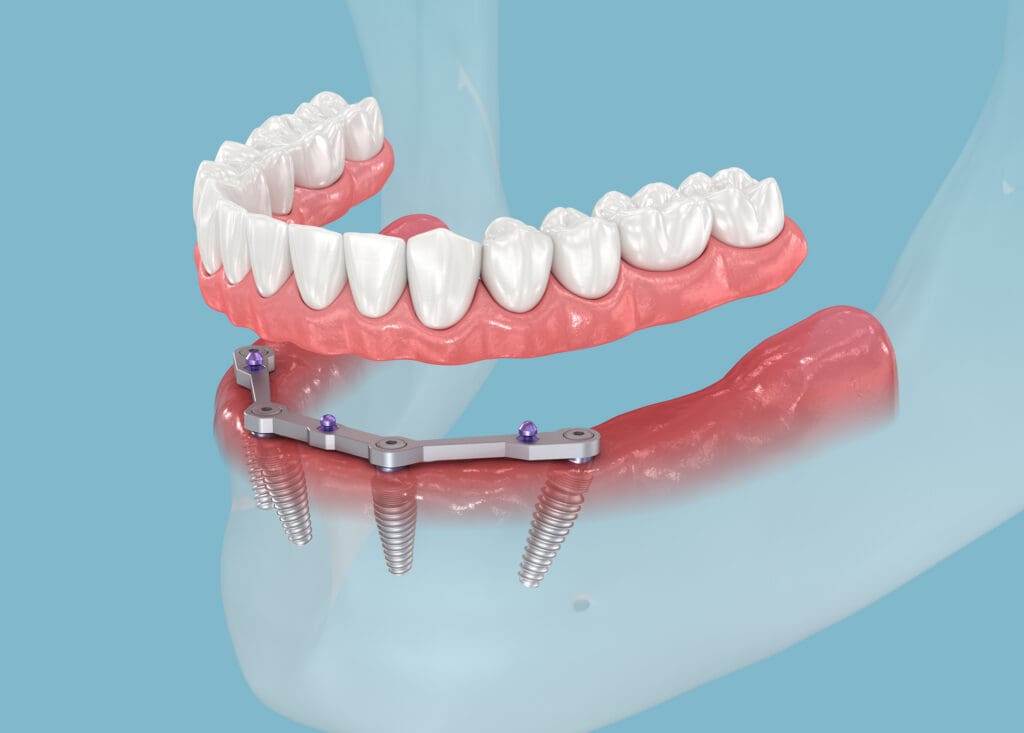
This is where dental implants become more than a replacement tooth. An implant is a small titanium post that is surgically placed into your jawbone. It acts as an artificial tooth root.
The key to bone preservation is a process called osseointegration. Over several weeks to a few months, living bone tissue grows around and fuses directly to the implant surface. This creates a permanent, incredibly strong bond.
Once this bond forms, the implant can do something a bridge or denture simply cannot. It transfers chewing forces directly into the jawbone. This restores the biological stimulation the bone needs to maintain its density and volume. In essence, the implant “tricks” your body into thinking a natural tooth root is still there.
Comparing Implants to Other Options: A Clear Difference
To understand implants’ unique bone-preserving power, it helps to compare them with other common tooth replacement options.
Dentures and Traditional Bridges:
These restore the visible part of your smile, but they don’t address the root cause. Since they rest on the gums or attach to neighboring teeth, they don’t directly stimulate the underlying jawbone. The bone resorption process continues unimpeded. One reason dentures require refitting over time is that the jawbone underneath changes shape as it shrinks.
Dental Implants:
An implant is the only tooth replacement option that replaces the tooth root, not just the crown. This root replacement makes all the difference in preserving bone health and preventing the facial changes associated with long-term tooth loss.
A Legacy of Excellence in Bryn Mawr
Dr. John E. Richardson and the team at Bryn Mawr Dental Health Group understand the importance of this principle. Dr. Richardson, a third-generation dentist, has been recognized as a Philadelphia Magazine Top Dentist every year from 2012 through 2024. With over 20 years of experience, he and his colleagues provide a full range of implant services. They are committed not just to restoring your smile, but to protecting your long-term oral and facial health.
Preserving Your Smile and Your Structure
If you are missing a tooth, deciding how to replace it is an important choice. It’s not just about filling a gap today. It’s about preserving your facial structure for the future.
Dental implants are an investment in your health and appearance. By mimicking the natural function of a tooth root, they stimulate the jawbone, prevent bone loss, and help you maintain the natural, youthful contours of your face.
Your journey to a healthier, more confident smile starts with a conversation. If you’re considering dental implants, trust your smile to a team that has earned peers’ respect and patients’ loyalty for decades.
Call Bryn Mawr Dental Health Group today at (610) 897-0825 or request an appointment online anytime.